It takes a village to do my Christmas shopping.

Y’all know I love a good barter. What I hate is shopping. Malls make me cry, and Wal*Mart makes me hyperventilate.

Over the years, however, I have managed to get my Christmas shopping down to a stress-free science. My goal is to give Christmas gifts that are full of love and joy, that support the local economy as much as possible, and that recognize who the recipient is and what they need and appreciate. Pardon my bragging, but yes, I can do this without ever setting foot in a mall or a big-box store.

My approach changes slightly every year. Always there are the homemade jams, and in more recent years I have added knitting. This year, however, I actually did go somewhere. I walked two doors down, to my neighbor Emily’s house. Talk about keeping it local!

Genius at Work

Earlier this year, Emily decided to do what she does best. In the past, she has been an excellent teacher, and briefly she was an advocate for families of children with learning disabilities in a law practice, but Emily’s true gift is at the sewing table. I have never known anyone with her eye for bringing together color, texture, and pattern in completely new and beautiful ways.

Today the mother of three really cute children, Emily learned to sew years ago as a newlywed living in rural New Mexico, worlds away from anything like the neighborhood where we live now — where our houses sit a few feet apart and where we don’t hesitate to walk into one another’s homes to borrow milk, pine nuts, a glass of wine, a can of tomatoes or beans. I love this about my little street in Decatur. We have impromptu parties all the time. We are all up in one another’s business, and it’s great. This village is my family.

I have had a front-row view of Emily’s process of turning a self-taught hobby into a cottage industry (literally — she sews in the front room of her cottage). Baby clothes, coffee cozies, lavender-scented eye masks, teddy bears, fabric-covered journals, shoulder bags — stuff just started pouring out of her sewing machine and filling up her house. So she secured a booth at a local arts fair last spring and started selling it. Then she did it again at another crafts fair. Suddenly, her business was taking off.

I said, “Emily, you need a website.”

So one night last summer over a glass of wine, she and I worked out a barter — a website for her in exchange for Christmas shopping for me.

Here is Emily’s business website (the business is called Two Peas): http://twopeasbyhand.com/

And here are some of her creations. (Don’t ask me whether it’s stuff I got in our barter, because you might be on my Christmas list, and I’m not telling!)


Emily is on Etsy, too. Check her out! She is still cranking out adorable things (cashmere bunnies! Owl heat packs from recycled wool sweaters!), so you can still place Christmas orders.

1 Comment

Filed under Community and Citizenship, Making things

Hoop Dreams

Regular readers of this blog know of my ongoing war with the evil squirrels who are intent on decimating my garden. My best defense so far has been the squirrel-proof net tent, which has covered the garden bed closest to the house for 2 1/2 years. It has worked magnificently, but tough luck for the several other garden patches I have growing in other parts of the backyard, exposed to the wiles of these demonic creatures.

The largest of these areas is a 20 x 25 bed next to the chicken coop. It’s too big for a giant net tent like the one next to the house, so I  usually grow crops back there that the squirrels aren’t likely to be interested in—peas, beans, arugula.

I decided, however, to see if I couldn’t take advantage of that area for a winter garden this year, to give the SPNT bed a rest. But instead of enclosing the whole area under a net, I decided to cover just a portion of it with hoop houses. I’ve seen hoop houses work on a smaller scale, mostly over raised beds, and I could see no reason why they wouldn’t work for a longer bed about five feet in width.

Off to Home Depot I went for ten-foot lengths of PVC, foot-long sections of rebar, zip ties, garden netting, and spring clamps.

Supplies

And here’s what I did with all of that:

The rebar went into the ground in pairs five feet apart, spaced about every four feet.
I bent the PVC over and secured each end on the pairs of rebar.
Over the bent PVC I draped the netting and secured it with the zip ties. I left a “tent flap” on the front as a entrance and secured it with spring clamps.

Inside the hoop house I have planted kale, Swiss chard, and cilantro—all things that the squirrels of eee-ville dug up and ate when I planted them in that area last year. I’m pleased to report that a few weeks after I built the hoop house, everything is thriving unmolested. Here’s what the kale looks like today.

I have started a second hoop house but haven’t yet covered it with netting. All my fall seedlings are planted out, so I have nothing to plant in that space until spring! I’m hoping that will be a great space for tomatoes, eggplant, and peppers next year.

Leave a Comment

Filed under Gardening, Making things

Southern Urban Homestead FAIL

Typically I am pretty good about owning up to my disasters. It’s a whole nuther thing, however, to own up to them on a public blog. But I’ve decided, as a character-building exercise and to show that perfection is not the goal in this ongoing quest of mine for balance and bounty in the city, to fess up to some of my most spectacular flops. I hope you enjoy them and won’t think less of my skillz.

Blackberry Rude (as opposed to “Cordial”)

Last year I went crazy with the blackberry picking. I made jams and cobblers and stuck some in the freezer for fruity desserts at the holidays. And I still had about a half gallon of berries left, so I decide to steep them in some vodka and sugar with a few spices. I had visions of Anne of Green Gables and the delicious raspberry cordial she mistakenly served to her bosom friend, Diana, in a chapter titled “Diana is Invited to Tea with Tragic Results.”

Tragic results indeed. Eight weeks later I strained the blackberries out of the liquid and bottled it all up. It was so pretty–dark reddish purple and clear in the jars. I was imagining creative cocktails, ice cream concoctions, and just some tasty sipping. What I got, however, was cough syrup. Ew. I think I just overdid it with the cloves. They overpower the flavor. I can’t bring myself to dump it all out (that was good, expensive vodka), so let me know if you have a cold. I have a  home remedy to share.

The Soap with Ugly Dead Things In It

I really should stay out of Michael’s stores. I accidentally come home with all sorts of little fake crafty things that are unnatural and useless, such as the glycerin soap making kits, complete with blocks of glycerin and cute little plastic molds in the shapes of hearts and stars. It was supposed to be easy: melt the glycerin and pour it into the molds. But no. I had to make it a little more complicated by adding some herbs and essential oils.

Maybe my mistake was using fresh herbs. Because guess what? Glycerin soap does not preserve lavender, eucalyptus, and rosemary as fresh green, succulent leaves. No, the sprigs of lovely shrivel and turn brown, emanating dark, gooey halos suspended in the hardened soap. Best to leave the soapmaking to those who know what they are doing.

Persimmon Poo

When I gathered the persimmons from a nearby tree last fall, I had a vague idea in my head about persimmon butter. Finding nothing helpful in my home canning and preserving books, I googled around and learned, first off, that persimmons don’t have enough acid to be canned without growing yourself a healthy crop of botulism. So I settled on freezer butter. And here is why googling can be bad for your health: I took a recipe here and a recipe there, made some substitutions, added some spices, took a few calculated risks and short cuts. Cooked it down, put it in jars, processed it, stuck it in the freezer.

The day I concocted this mess, my parents were visiting. I showed my father one of my jars of persimmon butter. My dad is typically a poker face, but when he peered into the jar, well, let’s just say his look betrayed his skepticism. “That looks interesting,” he said. A few weeks later I opened the freezer and pulled out a jar of “persimmon butter.” Rather than the brilliant autumnal gold I was expecting, it had turned sort of brown–a bad sign I chose to ignore. I thawed the jar and opened it. The substance within had shrunk away from the sides of the jar and thawed into a dry, solid chunk of you-guessed-it.


Do Not Neglect The Cucumbers

Generally I am a successful cucumber grower. I make nice, fluffy, generous hills and enrich them with buckets of compost. I mulch deeply and water often. I make lots and lots of pickles. This year, I got cocky. My cucumbers, I told myself, would know what to do. So I made a few hills, stuck the seeds in, and proceeded to neglect them.

What I got was an infestation of squash bugs that chewed everything I had planted to a withered crisp. I saw the first few appear and instead of picking them off and dusting with diatomaceous earth, I decided my historically vigorous cukes would fight the good fight and win . . . simply by virtue of being my cukes. But no, the squash bugs won, and I got no cukes this year. Here is what they looked like. Try not to cry.

A few careless mistakes, a few risks gone bad, a few lessons learned. But there are no morals to be drawn here. Just laugh, please, and if you happen to figure out persimmon butter, please share your recipe.

7 Comments

Filed under Gardening, Making things, Putting Up

My Pretty Great Housekeeping Seal of Approval

My neighbor Emily (who is also an amazing fabric crafter, and you should check out her website and buy her gorgeous homemade things) passed along a wonderful resource to me the other day. Remember how excited I was to find a recipe for homemade laundry detergent? Well, here is a whole array of homemade housecleaning products. These are on the website of the David Suzuki Foundation, downloadable from this page as a .pdf. I’ve tried a few of these, and so far my favorites are the carpet deodorizer and the all-purpose cleaner #1.

The great thing about these recipes is that they call for ingredients I just have around the house anyway — stuff like baking soda, borax (my new favorite cure-all — sprinkle it around the exterior of hour house to keep those annoying sugar ants out), castile soap, lemon juice, vinegar.

Here is the carpet deodorizer: baking soda, corn starch, bay leaves, and ground cloves. I heated the tip of an ice pick over the gas flame and poked holes in this plastic container (these come from the DeKalb Farmer’s Market when you buy parmesan cheese) to create a “shaker” for it. Worked perfectly for sprinkling over my carpets and rugs. I’ll store it by stacking it inside another identical plastic container.

And here is the all-purpose cleaner: castile soap (I used peppermint), white vinegar, hot water, borax. And an old plastic spray bottle.

I used it on my kitchen counters and bathrooms. Right now, my house smells like cloves and peppermint instead of wet dog. Nice!

4 Comments

Filed under Making things

Upside-Down Economics

For me, one of the great rewards of the “urban homesteading” lifestyle is that it enables me to live pretty frugally. Or perhaps “frugal” is not exactly the right word. More accurately, I have greater control and choice over where my hard-earned dollars go. It shifts some of the variables in the cost-of-living equation.

For example, instead of spending lots on utility bills and things like Tide laundry detergent, I use a clothesline and make my own laundry soap. There is some meat in my diet, but it isn’t a daily thing. I get a lot of protein from other sources (eggs, beans + grains, and my dearly beloved cheese)—which is much less expensive, so when I do buy meat, I can splurge on something local, sustainable, grass-fed, and fabulous. If I grow a lot of my own food and buy from local farmers, I’m putting my money into a local organic chicken feed co-op and Saturday farmer’s market instead of the fossil fuel industry.

One of the conundrums, though, of the “locavore” movement is that it has upscaled quality basic ingredients. Restaurants that feature locally and sustainably grown foods tend to be very pricey. Unless you are at a certain income level, a McDonald’s hamburger meal is still going to be the more practical option than, say, a Farm Burger  meal—which is an incredibly good value but still more expensive than McDonald’s. I love that Decatur’s local farmer’s market accepts Electronic Benefits Transfer  (EBT — the electronic version of food stamps from the state) cards and that it is strategically located within easy walking distance of the city’s public housing development. But then again, if you’re stretching your EBT allocation as far as it can go, and you can get a much bigger bunch of carrots at Kroger, where would your common sense take you?

These complicated questions about food, sustainability, class, culture, accessibility, and economy are beginning to filter into the media. NPR recently ran this story about Hardwick, Vermont, a town many think of as a kind of epicenter for local food production in the Northeast. But as one Hardwick high school student observed, “There’s the side of the town that’s for the local food movement, but I think there’s an even greater side of the town, with more people, that can’t afford the local food. I work at our local supermarket grocery store, and I see most of the people in town there.” One farmer in the area is responding to this concern by introducing a more “industrial” edge to his processing: more frozen, pre-washed fruits and vegetables that will be packaged specifically for the local supermarkets.

And yesterday, a piece in the New York Times about locavore queen Barbara Kingsolver’s husband, Steven Hopp, who has struggled in the last several years to start a restaurant in Meadowview, Virginia, where they live, in the heart of the Appalachians. The concept for Harvest Table is noble: locally sourced produce, meats, and cheeses; other stuff that they ship in is organic and/or fair trade. His vision is egalitarian, “built by and caters to the community,” the article explains. But Harvest Table has yet to make a profit in its four years. It’s too expensive for the locals. The average annual income in the area is $15,750. From the article: “‘If you go over there and eat, you have to pay $20,’ said Kay Thomas, 69, who has been farming in Meadowview with her husband for a half-century. ‘You can go to Pizza Hut and eat for $6. With the economy the way it is, you have to watch what you do.’”

What kind of upside-down economic system renders the most basic, most simple, most easily produced food the least accessible? What can you do to turn it aright? For me, it goes back to that question of redirecting my resources — and it goes to thinking about my lifestyle in simple economic terms. If I make some kind of purchase for my garden — for instance, a Growcamp that I spent $600 on earlier this year — I think of it in the long-term, and as an investment for future food production. Last year I hired someone to help me improve my rainwater catchment system — a significant up-front expense, but I haven’t watered my garden from a spigot on the house at all this year.

Maybe “frugal” is the right word, after all. I want my food to be cheap. So I consider the flow of goods and funds in a different way. If I sell a few dozen eggs, my fancy organic chicken feed is paid for. As regular readers know, I’m always on the hunt for a good barter and the alt-economy it helps create. The value of goods and services seem more real somehow, and so maybe in some scheme it helps bring the greater system back down to earth.

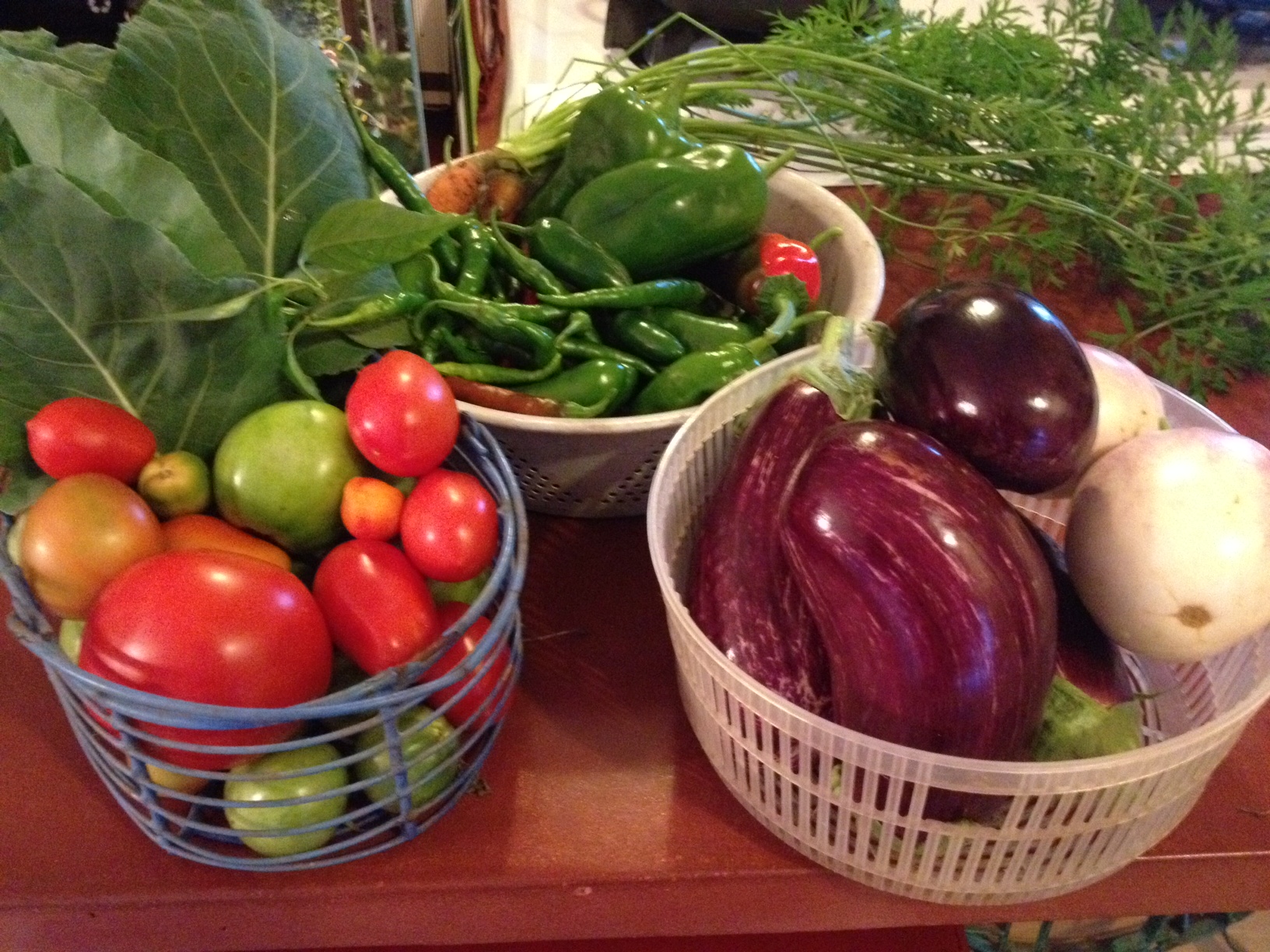
And while I love and appreciate  the upscale restaurants that have embraced the local food trend, especially the ones right around here in Decatur, I also love preparing great meals at home with food I have grown myself. They are very cost-efficient if I think about what ingredients I have on hand and build a menu from that: Flour, water, salt, and yeast. Mushrooms, tomatoes, peppers, eggplant from my garden.

Suddenly, my pizza is cheaper than Pizza Hut’s, and much more delicious.

4 Comments

Filed under Community and Citizenship

Jam Fusion

Every year about this time, fruit ripens all around me. I’m a longtime jam and butter maker: strawberry, blueberry, blackberry, fig, apple, pear, among others. It’s a basic concoction of fruit and sugar and sometimes a splash of lemon juice.

It’s always delicious, but it’s pretty much fruit and sweet. Last summer, though, a friend gave me a jar of raspberry-balsamic jam. I loved the piquant tang behind the fruit, and I realized the creative possibilities that I had not even begun to explore. So when the pears came in with the fall, instead of straight-up pear jam, I added some fresh grated ginger to the bubbling fruit, and voilá! Pear-ginger jam.

My friend Beth from New England came to visit that October. Beth has one of the most adventurous palates of anyone I have ever known (and one of these days I’m going to get her to write a guest blog post on some of her ice cream creations, which are amazing), and she is a discerning cheese lover. So I requested that she bring some cheese from her beloved cheese shop, and for several days she and I wolfed down cheese with giant dollops of the pear-ginger jam, the perfect complement. I sent her home with a big jar, which, she reported, didn’t last long.

With that success in mind, when the strawberries came in in May, I did some research and came up with a recipe for strawberry lavender jam. Fusing these flavors take a little longer because you actually have to allow the strawberries and lavender to macerate together in sugar for hours—24, in my case. You layer the lavender on top of the strawberries and pour sugar on top, then chill. They look like they’ve been sitting in snow—really quite lovely. Then you add some more lavender to the pot when you boil the fruit and sugar, and remove all the stems before processing in jars in a hot water bath. My kitchen was incredibly fragrant, and the resulting jam is nuanced and delicious.

Now the blackberries are coming in, and I got  brave and made up a flavor combination on my own. A fan of cardamom paired with other fruits, I added a teaspoon of this unique Indian space to nine cups of blackberries and six cups of sugar. It’s a delicate, complex fragrance at the moment, while it’s boiling away on the stove, and I can’t wait to sample the result.

I’m interested to know what other interesting fusions have successfully wound up in jams, jellies, and preserves. Readers, please share your experiments and recipes!

3 Comments

Filed under Putting Up

Micromanaging

Yesterday's kale.

Yesterday afternoon, in 95-degree temperatures, I harvested kale, broccoli, Swiss chard, and sugar snap peas. All of these are considered cool-season crops, and I have been impressed by their persistence as late spring has slammed us with some relentless midsummer temperatures this year. The greens and broccoli keep producing when by all rights they should bolt, flower, and go to seed. The sugar snap vines keep sending forth new blossoms when really it’s time for them to wither and brown.

What is going on here?

I’ve been reading a little about microclimates. A microclimate receives a kind of exemption from the rules of the USDA plant hardiness zones, which tend to govern gardeners’ decisions about what and when to plant. (Do you know your zone? If you live near me, you’re in Zone 7b. You can find your zone by zip code at the National Gardening Association website.)

Chard, broccoli, then the glimpse of a reddening tomato a few feet away.

Back to the microclimates: sometimes there are factors, or structures, or topographical/landscape features in tiny, specific areas where the rules simply change. Take my gardens, for example. I have lots of beautiful old oak trees on my lot, and I have had to work hard to plant around the prevailing shade. So while my veggies get enough sun every day to thrive, they do not get a ton of sun. There are little areas in my garden beds that stay pretty cool, and that’s where the kale, chard, peas, and broccoli are.

On the other hand, a mere six feet away, closer to the northern wall of my house, which gets lots of summer sun and therefore radiates heat, the tomatoes are starting to turn red—another microclimate.

As we gardeners encounter the exigencies of global warming, we are going to have to learn to microclimate manage. Therefore it’s probably a good idea to become more aware of the particulars of our own microclimates. Take some time to just study your garden beds over time. Experiment and compare. And do some reading. The best explanation I have found on the internet of microclimates is here, on the Cornell University Department of Horticulture website. The article begins with a great little piece of wisdom from one of their extension agents:

In the real world, we garden in microclimates, not hardiness zones.

Get to know your microclimates!

2 Comments

Filed under Gardening

Broken Tree

Readers might recall that back in the late fall I set two apple tree whips into the little strip of earth between the sidewalk and the street in front of my house. I chose that location deliberately, because I very much like the idea of sharing those fruit trees with my neighbors. In fact, while I was digging the holes, Anna, the eleven-year-old girl who lives next door, watched me with curiosity, asked what I was doing, and ended up helping me backfill the holes with soil and compost around the root balls.

Baby apple tree with new growth

I was delighted when those two twiggy  saplings began to show some signs of life. Green shoots emerged from brown bumps — first tentatively, then with a rush of vigor. I went out in April and looped string over the branched of both trees, then secured the string down taut in the ground with bent pieces of wire coat hangers to encourage the branches to grow horizontally, prompted by this comment on my original post about the trees.

And then one day, heartbreak. I came home from work to find that the top third of one of the trees had been broken off. By someone or something, I don’t know. On purpose or by accident, I don’t know. But someone had tried, strangely, to put the tree back together. The broken top of the trunk had been propped back up and was listing crazily to one side, held in fragile place by the strings, which had been haphazardly rearranged. I took the broken-off part into the house and put it in a jar of water, where it remains, even though the leaves are beginning to yellow. I haven’t been able to let it go. And for several days after, I couldn’t even look at the broken tree, it made me so sad. I think my feelings were hurt.

What amazed me, though, was that I wasn’t the only one distressed by the fate of that little tree. Over the next few days, many neighbors stopped me to tell me how upset they had been, too — that they had been keeping a fond eye on those trees since I had planted them. I had left the nursery tags on them so that passers-by could note that they were Fuji and Gala apples. Unbeknownst to me, folks had been as thrilled as I was to watch those green shoots emerge. They were curious about the web of string stretching the branches out as they grew. I wasn’t the only one with visions of a little apple festival on our street in the fall. And the sadness we all shared over the broken tree really was a kind of grief, as if a neighbor had suffered an injury.

The good news is that while the broken tree looks a little funny, I think it’s going to be just fine. It continues to push out new spring growth. It is shorter than its mate, but I’m hoping what it lacks in height it will eventually make up for in girth.

Even without apples — even before they bore a single leaf — those trees are already bearing a kind of fruit. I think they are off to a fine start.

1 Comment

Filed under Community and Citizenship, Gardening

Time to Eat

In the past week or two the sheer volume and scope of food rising out of the earth has exploded. One can literally make a meal standing in the middle of the garden, picking, and eating.

Lots of what is ready in my garden never makes it into the house (the strawberries especially), but I did manage to get enough basil into my basket to makethe first batch of pesto of the season on Monday, tossing some into some cappelini and fresh sugar snap peas and freezing the rest. On Wednesday I harvested kale, cilantro, more sugar snaps, and mushrooms for a stir-fry with ginger and tofu. I have also picked six pints of strawberries this week; two went into the freezer for ice cream I’m planning to make for a special party the week after next, and the rest will go into some jam.

The mulberries are starting to come in, too, and a lot of folks have been picking them off the trees that hang heavy over the streets in my neighborhood and making pies. I picked about three cups today during my long morning walk with Caleb, and when I got home I decided I wanted to try making some scones. I modified a recipe I found for oatmeal scones, adding a touch of orange extract and using the mulberries instead of currants, and here is the result. In a few minutes I will  take a few of these next door to my neighbors.

The sugar snaps are copious and remarkably sweet this year. I love them in the pasta and stir fry, but I also love them fresh and crunchy, right off the vine.  That’s the experience I had in mind when I took a platter of them to a little farewell gathering this week for a friend who is moving away. I mounded some hummus in the middle of them, tossed on some kalamata olives and feta cheese, drizzled it all with olive oil, and sprinkled salt. Here’s what the platter looked like.

Enjoy this lovely day! I’m going to pick more sugar snaps.

2 Comments

Filed under Feasting, Foraging, Gardening

The Library Boks

Last Thursday about mid-morning, I received an email from a neighbor of mine who works in the Woodruff Library at Emory University: “I hear numbers between 15-20 for chickens in the library this morning. They are all rounded up, do you think there is a chicken rescue out there, or neighbors that would be interested? I think the library has called animal control.”

Now that is an email one doesn’t see coming, even in the life of an urban homesteader. But I have worked at Emory as a writer and an editor for seventeen years, and for some reason the message felt like a natural confluence of two aspects of my life that don’t usually overlap. So I got right on it. I called the library and begged them to hold off on calling Animal Control . . . too late! The birds were on their way to chicken jail.

But the librarian filled me in: some members of the Emory University Senior Class of 2011, in a classic “college prank” maneuver, released a bunch of pullets, a couple of hens, and a rooster in the reference section of the library. Here is the video of the birds making quite an impression on a bunch of strung-out students in the middle of final exams:

And here is a video one of the librarians took after the security crew rounded them up in the loading dock area and secured them with — what else? — book cases (I’m really sorry I missed seeing that):

Undeterred, I then called my next-door neighbor and one of my partners in all things chicken, Bill, and begged him to drop whatever he was busy doing and drive over to Animal Control with me. He laughed and, not one to dodge a wacky adventure, helped me load up as many animal carriers as we had between the two of us into his Jeep, and away we went. Here is the video I shot of our trip:

We brought home ten. I sent a few emails, and by the end of the day, I had identified more experienced flockkeepers willing to adopt them than I had chickens to place in new homes. So I decided to return to Animal Control on Saturday morning for the rest. But by the time I got there, the others had all been taken, save the rooster, who had wriggled free at some point and is now roaming the woods around Animal Control (I have secretly named him Lynyrd, as in “Freebird”).

The ten we gathered up seem vigorous and healthy. The little hen, whom we have decided to keep for ourselves, is already laying (we have named her Dooley, and the other two we are keeping are Charlotte Brontë and Dorothy Sayers, since they had such literary beginnings with us).

The Library Boks, taking it easy with a snack and some sunshine after their big exciting day.

The Library Boks will spend a full week in quarantine to make sure they are free from any sneaky diseases that might spread to other flocks. I devoted most of this weekend to placing them with their new families and helping folks figure out how to best manage the transition (the key is to do it gradually and to give the new birds a safe place to hang out while it’s happening, and to not be alarmed by some aggression while the pecking order is being established). Everyone who took some of the birds agreed to follow through on the quarantine. Here are some pictures of them as they meet their new flockkeepers:

David, with the pair of white ones he took home

Rebekah and Walton with two of the three they took home

And Rebekah with the third one

Scott and Margo with their adoptees, who have already been named "Emory" and Eagle"!

I know some have been troubled by the student pranksters’ lack of regard for the animals’ welfare. But chickens are resilient creatures, and these birds seem to have not been too traumatized. And they all have good homes and will have the best possible life a chicken can have. I love a happy ending.

5 Comments

Filed under Community and Citizenship, Flockkeeping